> For the complete documentation index, see [llms.txt](https://inacks.gitbook.io/inacks-is3751-dmx-to-addressable-led/llms.txt). Markdown versions of documentation pages are available by appending `.md` to page URLs; this page is available as [Markdown](https://inacks.gitbook.io/inacks-is3751-dmx-to-addressable-led/is3751-examples/hardware-example.md).
# Hardware Example
*The following chapter represents an application design example for explanation proposals and is not part of the product standard. The customer must design his own solution, choose its most appropriate components and validate the final product according to the legislation and the DMX512 specifications.*
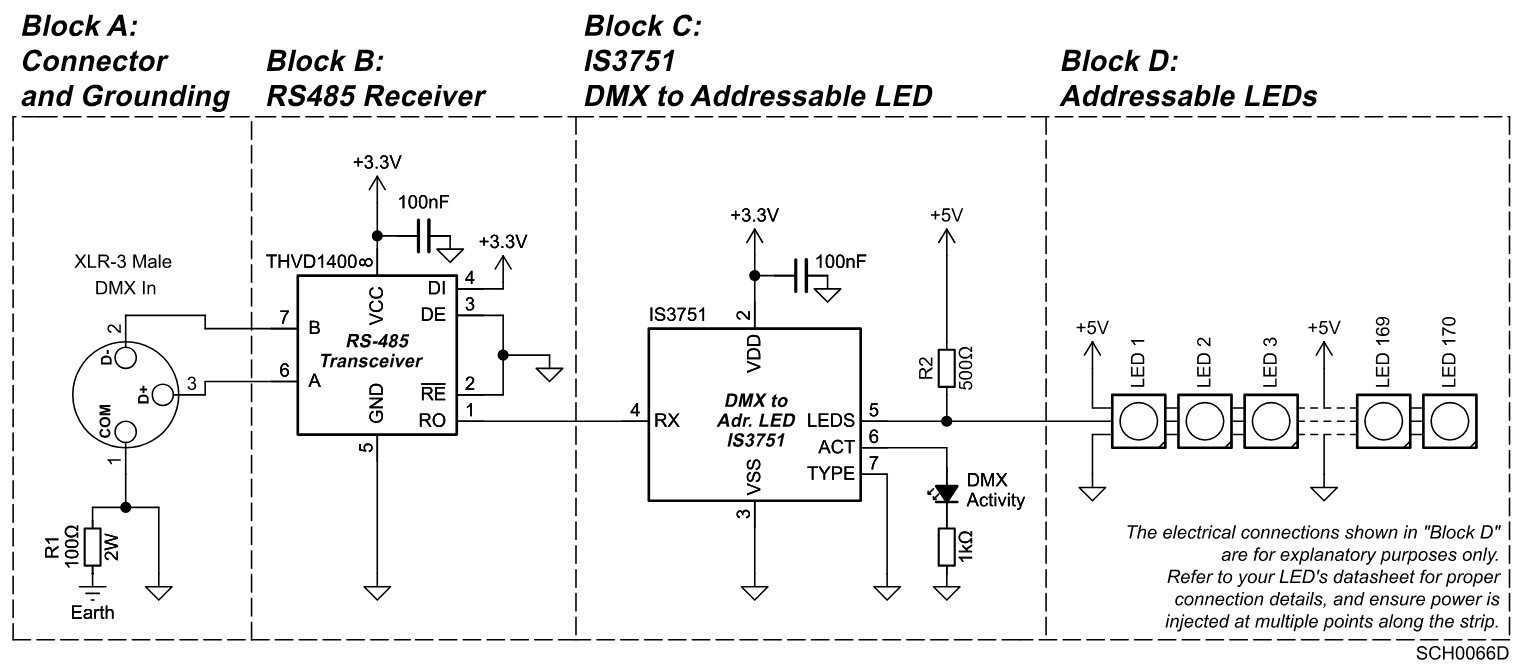
This example shows the design of a standard DMX to Addressable LED schematic using the IS3751.
#### Block A: Connector and Grounding
**Connector**
The official DMX connector is the XLR-5. Exceptions include RJ45, miniature connectors, and screw terminal connectors. However, despite its popularity and widespread use, XLR-3 is not part of the DMX standard and should not be used. But what happens in the real world and in this example?
Generally, XLR-3 connectors are cheaper than XLR-5 connectors. Therefore, XLR-5 connectors are typically found in professional equipment, while XLR-3 connectors are more common in cost-sensitive devices.
In this example, an XLR-3 connector has been used due to its widespread popularity and clarity of implementation, but we strongly encourage product designers to follow the standard and use XLR-5 connectors.
Using an XLR-3 connector has the drawback of making your product compatible with standard microphone cables, which are specifically designed for low-frequency analog audio—not digital signals. As a result, microphone cables are not suitable for DMX, as they degrade the DMX signal, reducing the maximum cable length and increasing the chances of flickering.
DMX receivers usually feature two DMX connectors: a DMX In (male) and a DMX Out connector (female) for daisy‑chaining. However, since the IS3751 uses all the 512 DMX channels, no free channels remain. Therefore including a DMX Out connector has no practical purpose, and only a DMX In connector is shown in the example.
**Grounding and Isolation**
Grounding and isolation are complex topic, especially in long cable runs, where ground potentials can differ significantly, or when all the equipment is not powered from the same source, e.g., mixing mains line and a gasoline generator. High currents can flow through the shield of the DMX cable under these conditions, which can be dangerous. To limit this, a resistor (R1) of 100 Ω or less should be placed between the cable shield and Earth.
This example shows a design of a non-isolated receiver, which is the most popular design due its low cost and ease to design, although DMX standards recommend that DMX receivers be isolated.
For a non-isolated receiver, the standard requires the product to be labeled as “NON-ISO”.
**Cable**
Use only twister pair cable to carry the DMX signal.
The DMX cable screen must be connected to the pin 1 of the XLR-3 or XLR-5 connector and not to its shell.
Do not use microphone cable, as it has been designed to carry low-frequency signals, and it will degrade the DMX signal, increasing the chances of spurious flickers on the LED fixtures.
#### Block B: RS485 Receiver
DMX operates over the RS485 electrical standard. Therefore, an RS485 transceiver or receiver is required to convert the differential signals to TTL‑compatible voltage levels before connecting them to the IS3751.
Since IS3751 never sends DMX data, the DE and RE pins of the transceiver can be tied to GND to keep it always in receive mode.
Even if the transceiver is only used as a receiver and therefore the driver part will never be used, it is sometimes preferred because it can be cheaper than a receiver-only device. Compare distributor prices to validate your preferred option.
Either 3.3 V or 5 V transceivers and receivers can be used, as the RX pin of the IS3751 is 5 V tolerant.
#### Block C: IS3751
The IS3751 is very simple to integrate into your design.
The LEDS pin outputs the converted data for the addressable LEDs. This pin is open-collector, and since most addressable LEDs expect 5 V logic, it should be pulled up to 5 V with a 500 Ω resistor (see R2 in the example circuit). Using a lower resistor value will generate a stronger data signal. The minimum admissible value for this resistor is 250 Ω; going below this may cause permanent damage to the IS3751. A value of 500 Ω is recommended and provides a strong and reliable signal, while environments with long cable runs or electrical noise may benefit from a slightly lower value.
The RX pin receives the DMX data at TTL‑compatible voltage levels.
The TYPE pin selects between 3‑color (connect to GND) and 4‑color (connect to VDD) addressable LEDs.
ACT pin indicates when DMX data is being received.
A decoupling capacitor should be placed on the power pins (VDD and VSS). It is recommended to use a 100 nF ceramic capacitor.
#### Block D: Addressable LEDs
The IS3751 can control up to 170 3-color addressable LEDs or 128 4-color addressable LEDs.
When using more than a few LEDs, special attention must be given to the power supply design. Poor PCB layout or cabling in the power domain can lead to burnt traces or wires, voltage drops, and incorrect LED brightness or spurious flickering.
Always calculate the total current draw of all LEDs to properly size the power supply. Do not assume that certain colors won’t be used and therefore a smaller supply is sufficient. Always assume the worst case: all LED colors on at 100% brightness.
When powering LEDs from an external power supply, make sure the LEDs and the rest of the circuitry controlling the LEDs share the same voltage reference. The GND of the LEDs and the GND of your control circuit must be connected. Poor GND connections will cause LED flickering.
When the IS3751 and the first addressable LED are separated by more than 20 cm, add a 220 Ω to 470 Ω series resistor to the data line. This resistor protects the first LED from voltage spikes, reduces signal reflections, and helps ensure clean and reliable data transmission.
---
# Agent Instructions
This documentation is published with GitBook. GitBook is the documentation platform designed so that both humans and AI agents can read, navigate, and reason over technical content effectively. Learn more at gitbook.com.
## Querying This Documentation
If you need additional information that is not directly available in this page, you can query the documentation dynamically by asking a question.
Perform an HTTP GET request on the current page URL with the `ask` query parameter, and the optional `goal` query parameter:
```
GET https://inacks.gitbook.io/inacks-is3751-dmx-to-addressable-led/is3751-examples/hardware-example.md?ask=&goal=
```
`ask` is the immediate question: it should be specific, self-contained, and written in natural language.
`goal` is optional and describes the broader end goal you are ultimately trying to accomplish on behalf of the user. GitBook uses it to tailor the answer towards what is most useful for that goal.
The response will contain a direct answer to the question and relevant excerpts and sources from the documentation.
Use this mechanism when the answer is not explicitly present in the current page, you need clarification or additional context, or you want to retrieve related documentation sections.